Have you ever looked back at something you said or did and realized it was foolish? Most of our actions—our words, our decisions, our reactions—carry consequences. And behind those actions is something deeper: our attitude. What we dwell on, what we premeditate, slowly becomes the direction of our life.
Today, let us look at the lives of Samson and David—two men chosen by God—and ask an honest question: Which one do we resemble?
Both were part of God’s divine plan.
Both were called and anointed.
Both faced the same enemy—the Philistines.
Both encountered lions in their journey.
And tragically, both experienced a major failure involving a woman.
The similarities are striking—and perhaps uncomfortably familiar. But the real lesson lies not in what happened to them, but in how they responded. That difference determines whether God is pleased with our lives.
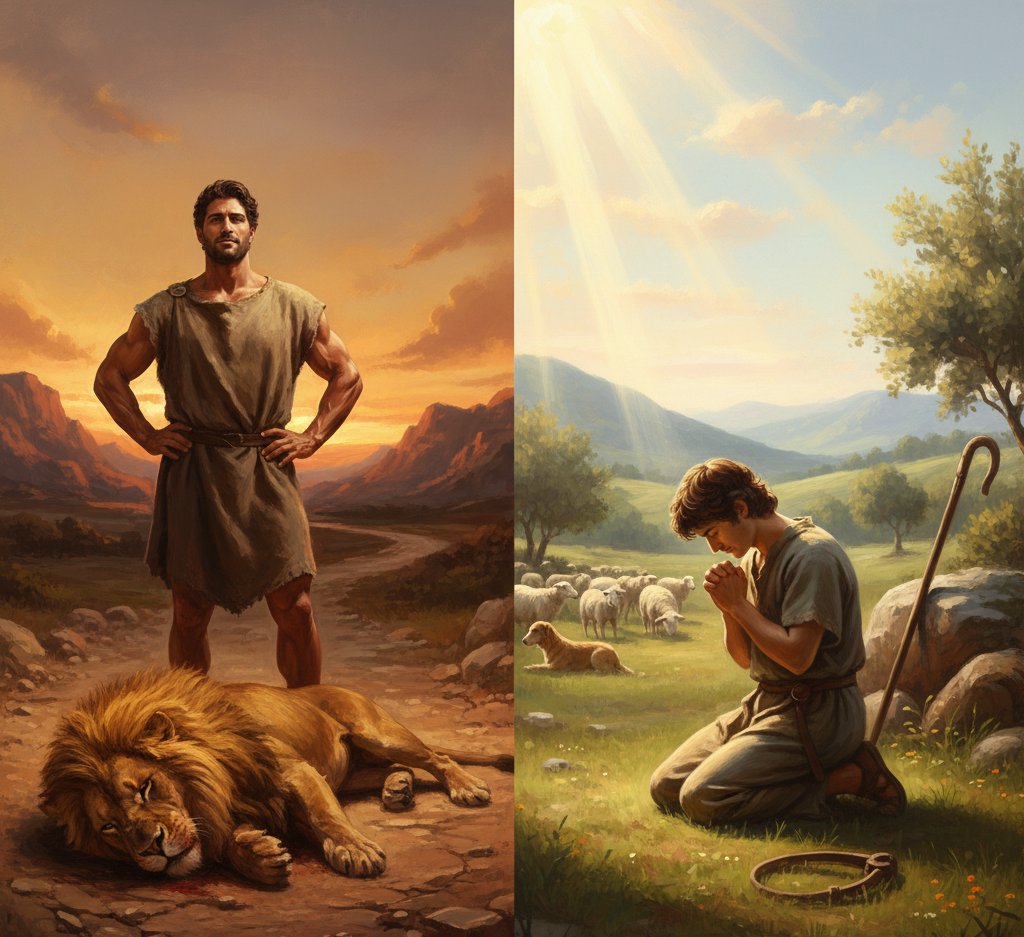
When Samson convinced his parents to arrange a marriage, they set out on a journey. On the way, a lion attacked him. Scripture says:
“The Spirit of the Lord came powerfully upon him, so that he tore the lion apart with his bare hands.”
—Judges 14:6
So far, everything looks good. God’s power, God’s victory.
David had a similar experience. While faithfully tending his father’s sheep, lions and bears came to attack the flock. David didn’t run. He fought—and won.
“Your servant has killed both the lion and the bear.”
—1 Samuel 17:36
In both cases, God enabled the victory. The lion was never the problem. What came after the victory was. After defeating the lion, Samson deliberately chose to walk back on the same road. Not because it was necessary—but because it was thrilling. This was a path not commonly taken, a road chosen by adventurers like Samson. But this time, he wasn’t just passing through. He stopped to look at the carcass of the lion. Worse—he touched it and scooped honey from it.
Samson was a Nazirite, set apart for God. He was not supposed to touch a dead body (Numbers 6:6). Yet here he was, violating his calling—not out of weakness, but out of curiosity and pride. This is where human nature reveals itself.
In our lives too, God may lead us through difficult, less-traveled paths. Lions may rise against us—but the Spirit of God gives us victory. The danger begins when we start revisiting old battles, relishing past victories, and developing an unseen confidence that says, “I can handle this.”
“Pride goes before destruction, a haughty spirit before a fall.”
—Proverbs 16:18
Victory made Samson careless. He forgot his purpose. Samson didn’t tell his parents what he had done. He hid the truth from those who were meant to guide him. Instead, he turned his sin into a riddle and shared it with his companions. Because of that riddle, his wedding was ruined. Conflict followed. Violence followed. What was hidden in private eventually exploded in public. Samson avoided accountability—and paid the price.
Now look at David. He did not go around announcing that he had killed lions and bears. He mentioned it only once—when Goliath challenged Israel and no one believed David could face him.
“The Lord who rescued me from the paw of the lion and the paw of the bear will rescue me from the hand of this Philistine.”
—1 Samuel 17:37
David didn’t use his victories to show off.
He used them to strengthen faith—his own and others’.
Today, when no enemy stands before us, we are tempted to speak like Samson—boasting of past wins. But when a Goliath appears, fear suddenly grips us. The question is: Who gets the credit for our victories?
Samson wanted admiration from companions. David wanted to remind people that no enemy can stand before God.
One painful detail stands out in Samson’s life: he prayed to God only once—at the very end, when he was blind, captured, and mocked by his enemies. David, on the other hand, prayed constantly—even when prayer seemed unnecessary.
When his enemies took his wives and children, David did not act on impulse. A warrior asking permission to fight sounds foolish to the world—but wise before God.
“David inquired of the Lord, ‘Shall I pursue this raiding party?’”
—1 Samuel 30:8
David put God first—even when logic said otherwise.
Let us ask ourselves honestly:
- Do our victories encourage others, or do they inflate our ego?
- Do we hide our struggles from mentors, or do we seek correction?
- Do we consult God only in desperation—or in every decision?
Samson hid his failures from his parents. David shared his life with God.
Winning battles is not difficult when God is with us. Maintaining humility, obedience, and relationship with God—that is the real challenge.
Be willing to reroute yourself away from paths where there is no accountability, no mentorship, and no godly correction. Otherwise, victory itself will become the reason for loss.
“What good is it for someone to gain the whole world, yet forfeit their soul?”
—Mark 8:36
Winning a battle is small if you lose your life’s purpose.
Winning in life matters.
Winning in character matters more.
This is the call for all those who belong to the Quiver of God.

May God bless you all
Blessed & Thoughtful Message