
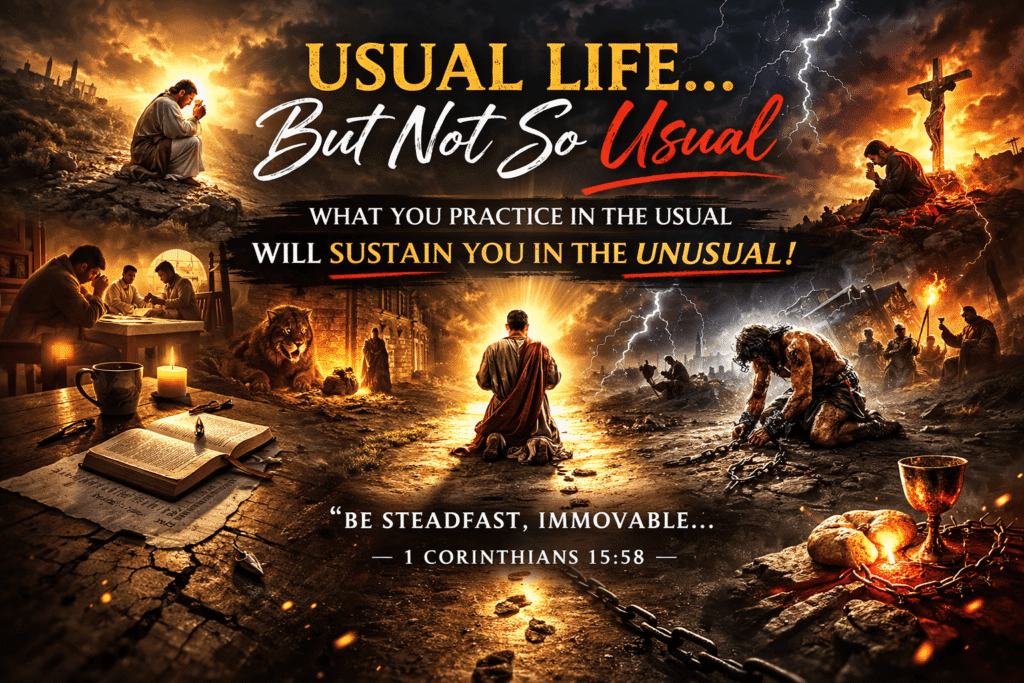
In our lives, we love what is usual. Usual faces. Usual food. Usual routines. Usual comforts. “Usual” feels safe. It feels predictable. It feels under control. But most of the time, “usual” simply means we have built a life around comfort. And comfort can quietly shape our spiritual life too. Yet not all usual things are bad.
Some “usuals” are built intentionally. Make it usual to pray. Make it usual to read the Word. Make it usual to examine your heart. Make it usual to grow.
Daniel didn’t suddenly become faithful in crisis — he had built a usual habit of prayer. Jesus didn’t start seeking the Father only in suffering — communion with God was already His pattern.
So the question is not whether we have “usuals.”
The question is: Are our usuals preparing us for the unusual?
Jesus Christ often withdrew to pray. It was His habit.
“As was His custom, He went to the Mount of Olives…” — Luke 22:39
Prayer was not a reaction for Jesus. It was rhythm. But that night in Gethsemane was not usual. That was the night of betrayal. Judas Iscariot was preparing to hand Him over. The weight of the cross was before Him. Yet Jesus still did what was usual — He prayed.
“Father, if You are willing, take this cup from Me; yet not My will, but Yours be done.” — Luke 22:42
“An angel from heaven appeared to Him and strengthened Him.” — Luke 22:43
The disciples? They did what was usual for them — they slept. “Could you not watch with Me one hour?” — Matthew 26:40
Here is the contrast:
- Jesus’ usual habit strengthened Him for the unusual moment.
- The disciples’ usual weakness exposed them in crisis.
What we repeat daily will reveal itself in our darkest hour.
Daniel had a pattern.
“He went home… opened his windows toward Jerusalem, and prayed… three times a day, as was his custom.” — Daniel 6:10
He didn’t start praying because danger came. He prayed because that was his life. But that day was not usual.Men were waiting. Watching. Planning. They had arranged for him to be thrown into the lions’ den. Daniel could have changed his routine. Closed the window. Skipped prayer. Adjusted. He did not.
God turned the “unusual” into a testimony.
“My God sent His angel and shut the lions’ mouths.” — Daniel 6:22
When faith is usual, fear loses power.
In biblical culture, the firstborn received the blessing. But when Isaac blessed Jacob instead of Esau, it broke tradition. It wasn’t usual. But God is not limited by human customs.
“The older shall serve the younger.” — Genesis 25:23
God sometimes disrupts our “usual” systems to fulfill His sovereign plan. But the story doesn’t stop there. Later, Jacob himself was deceived by Laban. He worked for Rachel but was given Leah. Laban said, “It is not the custom here…”
How interesting.
Jacob experienced what happens when human “usual” is used as an excuse. Yet Jacob did not abandon his calling. He kept moving toward what God had promised him.
Sometimes the usual will disappoint you. Sometimes the system will fail you. But the promise of God does not fail.
Samson had experienced victory again and again. Every time the Philistines came, the Spirit of the Lord empowered him. Strength had become usual. Victory had become usual. God’s presence had become usual.
Then came the tragic verse:
“He did not know that the Lord had left him.” — Judges 16:20
Samson thought he could shake himself free as usual. But that day was not usual. When we treat God’s grace casually…When we assume His presence automatically…When we stop guarding our hearts…
The victories that were usual can fade. The promises that were usual can feel distant. The presence that was usual can feel silent. Not because God changes — but because we drift.
Our lives are filled with “usuals.”
Usual prayers.
Usual worship.
Usual church attendance.
Usual routines.
But what happens when life becomes unusual?
- When betrayal comes?
- When opposition rises?
- When systems fail?
- When grace feels silent?
Will our usual habits carry us through? Or will we discover that our usual was only comfort, not conviction? Let us build the right usuals.
Let prayer be usual.
Let obedience be usual.
Let repentance be usual.
Let gratitude be usual.
So that when the unusual comes — and it will —
we will not collapse. Instead, we will stand.
“Be steadfast, immovable, always abounding in the work of the Lord…” — 1 Corinthians 15:58
Because a life rooted in God may look usual on the outside…But in the spirit, it is never ordinary. Let our usual habits be turned us to o be usual faces in the Quiver of GOD.


May God bless you all..